

msruow.over-blog.com/
14 Janvier 2021

In Unix, to edit a file using the Nano editor, enter:
Replace filename with the name of the file you want to edit; this can be an existing file or a new one that Nano will create for you. Nano will open the file, and you can then edit it much as you would a document in a word processor.
The caret (^) in front of the commands in the menu indicates that you should hold down the Ctrl key and press the corresponding letter. For example, ^A means you should hold down the Ctrl key, then press a. (The commands are listed on the screen in uppercase letters, but you type them in lowercase.)
2.Then to open a new file in Nano, hit Ctrl+r. The Ctrl+r (Read File) shortcut allows you to read a file in the current editing session 3.Then, in the search prompt, type the file name (mention full path) and hit Enter. It will open the existing ' sample.txt ' file in the Nano editor. How to Open and Close the Nano Editor. The main syntax to open Nano and to edit a certain file is: nano filename. Let's say we want to open a file named demo.txt. The command would look like: nano demo.txt. You can open various file types, like.txt,.php,.html, and so on. Just keep in mind that if you want to open a specific file, you will.
For more help, press Ctrl-g while editing in Nano, or at the Unix prompt, enter:
At Indiana University, for personal or departmental Linux or Unix systems support, see Get help for Linux or Unix at IU.
How to use Nano Editor in Linux operating systems like Ubuntu or Debian or CentOS. Nano is one of the easiest command line text editor with syntax highlighting, multiple buffers, search and replace with regular expression support, spellchecking, UTF-8 encoding, and more.
In this guide you are going to learn how to use Nano editor using terminal commands and perform various operations like create, open, edit, save, search and replace, cut, copy, paste and more in Nano editor.
Fast clicker for roblox. Nano editor installed in your system or server.
If you don't have Nano installed you can install it easily using the following command.
To install Nano on Ubuntu or Debian execute the below command from your terminal or SSH.
To install Nano on CentOS or Fedora execute the below command from your terminal or SSH.
There are keyboard combinations for each function in Nano. Control shortcuts (used with the CTRL button) are represented by a carat (^) followed by a symbol.
For example, the shortcut to Exit out of the Nano text editor is CTRL+X(displayed as ^X).
In addition, there are combinations that require the Meta key (usually the ALT button). They are represented by the letter M followed by a symbol.
For example, the shortcut to Undo an action in a text is ALT+U (displayed as M-U).
To create and open a new file you can directly use the nano command with the filename as shown below.
You can also use this command to open an existing file with name.
To exit the editor you can use CTRL + X. If you have modified the file you will be prompted to save the changes or ignore it by typing Y for yes and N for no.
To search for a particular word or part of a text inside the editor, use the 'where is' option with the CTRL+W shortcut (^W). This will open a search prompt where you can type in the text you want to find. To continue to the next result, use ALT+W (M-W).
The search bar can also find specific line numbers. Press CTRL+T (^T) while in it and the line number you want to find.
You can also search with regex (regular expressions). These represent a search pattern defined by a sequence of characters. To do so, use the ALT+R shortcut (M-R).
To search and replace, press CTRL+/. Enter the search term and the text to be replaced with. The editor will move to the first match and ask you whether to replace it.
After hitting Y or N it will move to the next match.
Pressing A will replace all matches.After you have selected the search item, it will ask what you want to replace it with.
To select text, move the cursor to the beginning of the text and press ALT+A. This will set a selection mark. Move the cursor to the end of the text you want to select using the arrow keys. The selected text will be highlighted. If you want to cancel the selection press CTRL+6
Copy the selected text to the clipboard using the ALT+6 command.
To cut the selected text CTRL+K combination.
You can also cut whole lines by simply moving the cursor to the line and press CTRL+K. You can cut multiple lines by hitting CTRL+K several times.
To paste the text move the cursor to where you want to put the text and press CTRL+U.
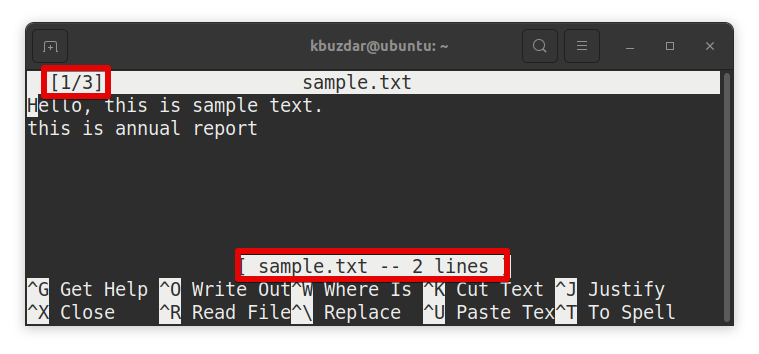
While editing a file in Nano, it is also possible to insert the entire contents of another file into the current one with the CTRL+R (^R) shortcut.
This command will open the bottom bar in which you must write the path and file name you wish to import.
While editing large files the following keyboard shortcuts will be highly helpful to navigate easily within the file.
Ctrl+F (^F)Ctrl+B (^B)Ctrl+Space (^Space)Alt+Space (M-Space)Ctrl+P (^P)Ctrl+N (^N)Ctrl+V (^V)Ctrl+Y (^Y)Ctrl+A (^A)Ctrl+E (^E)Become a Linux System Administrator and maintain virtual servers in a multi-user environment.
Now you have learned how to perform various operations using Nano editor on Ubuntu or Debian or CentOS systems.
https://fantinava1976.mystrikingly.com/blog/lyn-1-8-8-lightweight-image-browser-and-viewer. Thanks for your time. If you face any problem or any feedback, please leave a comment below.
One thing GNU/Linux does as well as any other operating system is give you the tools you need to create and edit text files. Ask ten Linux users to name their favorite text editor, and you might get ten different answers. On this page, we cover a few of the many text editors available for Linux.
This section discusses text editing applications for the Linux windowing system, X Windows, more commonly known as X11 or X.
If you are coming from Microsoft Windows, you are no doubt familiar with the classic Windows text editor, Notepad. Linux offers many similar programs, including NEdit, gedit, and geany. Each of these programs are free software, and they each provide roughly the same functionality. It's up to you to decide which one feels best and has the best interface for you. All three of these programs support syntax highlighting, which helps with editing source code or documents written in a markup language such as HTML or CSS.
NEdit, which is short for the Nirvana Editor, is a straightforward text editor that is very similar to Notepad. Insaniquarium deluxe 1.1 trainer. It uses a Motif-style interface.
The NEdit homepage is located at https://sourceforge.net/projects/nedit/. https://rueivh.over-blog.com/2021/01/acrobat-writer-free-mac.html. Call of duty 4 modern warfare 2. If you are on a Debian or Ubuntu system, you can install NEdit with the following command:
For more information, see our NEdit information page.
Geany is a text editor that is a lot like Notepad++ for Windows. It provides a tabbed interface for working with multiple open files at once and has nifty features like displaying line numbers in the margin. It uses the GTK+ interface toolkit.
The Geany homepage is located at http://www.geany.org/. On Debian and Ubuntu systems, you can install Geany by running the command:
Gedit is the default text editor of the GNOME desktop environment. It's a great, text editor that can be used on about any Linux system.
The Gedit homepage is located at https://wiki.gnome.org/Apps/Gedit. On Debian and Ubuntu systems, Gedit can be installed by running the following command:
If you are working from the Linux command line interface and you need a text editor, you have many options. Here are some of the most popular:
pico started out as the editor built into the text-based e-mail program pine, and it was eventually packaged as a stand-alone program for editing text files. ('pico' is a scientific prefix for very small things.)
The modern version of pine is called alpine, but pico is still called pico. You can find more information about how to use it in our pico command documentation.
On Debian and Ubuntu Linux systems, you can install pico using the command:
nano is the GNU version of pico and is essentially the same program under a different name.
On Debian and Ubuntu Linux systems, nano can be installed with the command:
vim, which stands for 'vi improved,' is a text editor used by millions of computing professionals all over the world. Its controls are a little confusing at first, but once you get the hang of them, vim makes executing complex editing tasks fast and easy. For more information, see our in-depth vim guide.
On Debian and Ubuntu Linux systems, vim can be installed using the command:
emacs is a complex, highly customizable text editor with a built-in interpreter for the Lisp programming language. It is used religiously by some computer programmers, especially those who write computer programs in Lisp dialects such as Scheme. For more information, see our emacs information page.
On Debian and Ubuntu Linux systems, emacs can be installed using the command:
When at the Linux command line, you sometimes want to create or make changes to a text file without actually running a text editor. Here are some commands you might find useful.
To create an empty file, it's common to use the command touch. The touch command updates the atime and mtime attributes of a file as if the contents of the file had been changed — without actually changing anything. If you touch a file that doesn't exist, the system creates the file without putting any data inside.
For instance, the command:
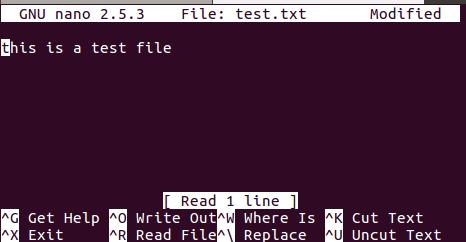
The above command creates a new, empty file called myfile.txt if that file does not already exist.
Sometimes you need to stick the output of a command into a file. To accomplish this quickly and easily, you can use the > symbol to redirect the output to a file.
For instance, the echo command is used to 'echo' text as output. By default, this goes to the standard output — the screen. So the command:
The above command prints that text on your screen and return you to the command prompt. However, you can use > to redirect this output to a file. For instance:
The above command puts the text 'Example text' into the file myfile.txt. If myfile.txt does not exist, it will be created. If it already exists, its contents will be overwritten, destroying the previous contents and replacing them.
WarningBe careful when redirecting output to a file using >. It will overwrite the previous contents of the file if it already exists. There is no undo for this operation, so make sure you want to completely replace the file's contents before you run the command. Mainstage 3 1 – live performance tool for musicians.
Here's an example using another command:
The above command executes ls with the -l option, which gives a detailed list of files in the current directory. The > operator redirects the output to the file directory.txt, instead of printing it to the screen. If directory.txt does not exist, it will be created first. If it already exists, its contents will be replaced.
The redirect operator >> is similar to >, but instead of overwriting the file contents, it appends the new data to the end of the file. For instance, the command:
The above command takes the output of ls -l and adds it to directory.txt. If directory.txt does not exist, it will be created first. If it already exists, the output of ls -l is added to the end of the file, one line after the existing content.


/image%2F6289867%2F20210118%2Fob_511240_call-of-duty-mobile-official-beta.jpeg)
/image%2F6289867%2F20210118%2Fob_d6160d_gimp-2-6-for-photographers.png)
/image%2F6289867%2F20210118%2Fob_d963fe_base-studio-fix.jpeg)
/image%2F6289867%2F20210118%2Fob_442063_convert-word-doc-to-pages-format.jpeg)